How to Recreate the Daft Punk & Patrick Alavi “Voyager” Bass
Producers assume this one is complicated. It’s a saw wave, a low filter and a touch of resonance.
The bass sound from Daft Punk’s “Voyager” has become one of those sounds that producers often assume is much more complicated than it actually is.
There are countless recreations using different synths and complicated processing chains, but the basic sound is surprisingly simple.
Start With a Saw Wave
The original Daft Punk bass was most likely made using a Roland Juno-106, although the exact setup was never confirmed. The important thing is that you don’t need a rare synth or complicated software to get close.
Start with a single saw wave.
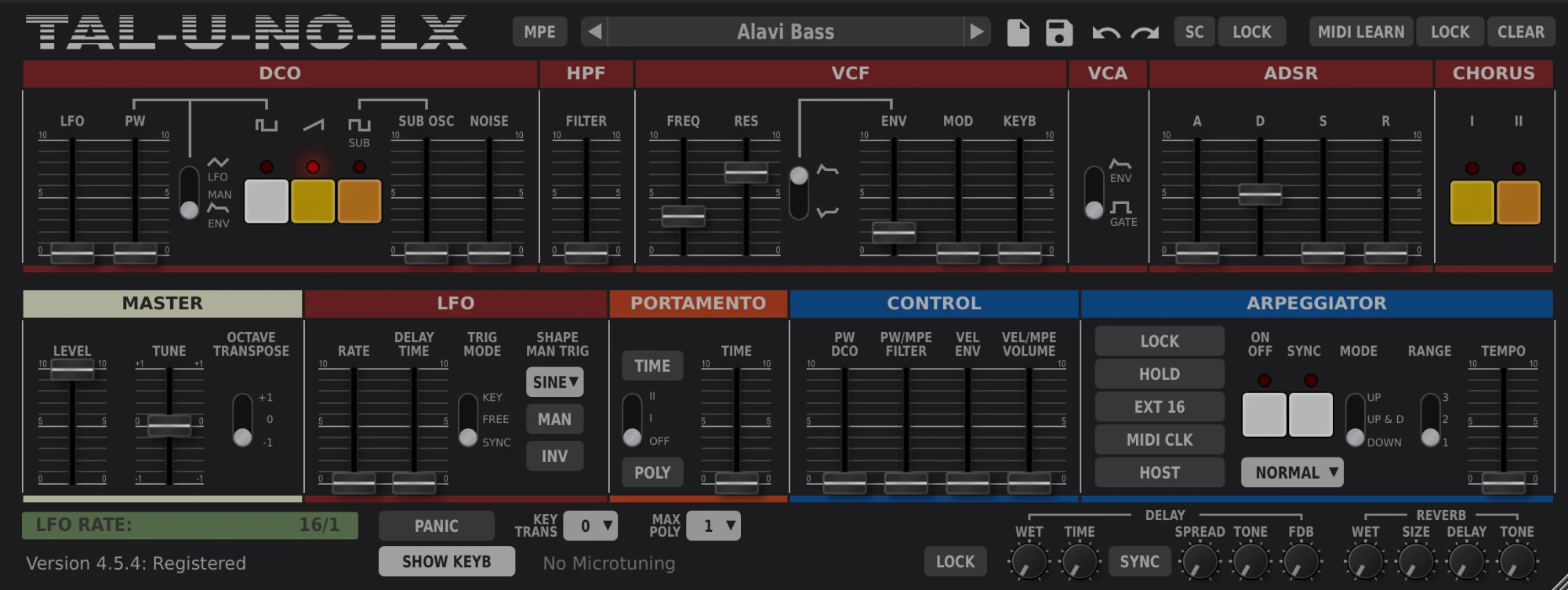
From there, use the filter to remove most of the high frequencies and push the resonance up high. In the patch the cutoff sits around 3 out of 10 with the resonance at about 7. The filter envelope is only a touch, under 2, just enough that the cutoff opens slightly when each note is played.
The other half of it is the amp envelope, and this is the part people miss. Attack, sustain and release are all at zero with the decay at about halfway, so every note is a short pluck rather than something that holds.
Patrick Alavi
Patrick Alavi’s productions use a lot of digital equipment and software, so it’s fair to assume that his version of this type of bass could have been created digitally.
But the same principle applies. You don’t need a particular piece of software to recreate the sound. The character comes primarily from the basic oscillator and filter settings.
For a modern recreation, almost any decent Juno-style emulation will work. In this example, I’ve included a TAL-U-No-LX patch that gets you into the right territory straight away. A slight low end boost might help it fit your track better.
Comments